BIA Classified File 005: The Memory That Didn't Belong to Nathan Cole
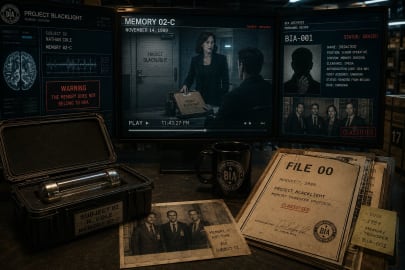
Memory 02-C
At 6:14 A.M., the black case remained unopened.
It sat in the center of the Blacklight storage room beneath BIA headquarters.
Six years of dust covered its surface.
Three lines were printed on the front:
SUBJECT 02
N. COLE
MEMORY 02-C
Every monitor around the room was dark.
Agent 17's final warning still remained on the terminal:
THE MEMORY DOES NOT BELONG TO HIM.
Director Adrian Hale stared at the case.
"What does that mean?"
Nobody answered.
There was only one way to find out.
They opened it.
There Was No Memory Inside
The investigators expected a tape.
A hard drive.
Documents.
Perhaps some kind of Blacklight storage device.
Instead, the case contained a small glass cylinder.
Inside it was a narrow metallic strip no longer than a finger.
An analyst recognized the technology from the Blacklight documentation recovered upstairs.
Extracted memories had not been stored as ordinary recordings.
Blacklight converted neurological patterns into encrypted data.
The original equipment required to read them was still inside the Memory Division.
The cylinder was carefully removed.
Then inserted into the Blacklight terminal.
For several seconds...
nothing happened.
Then every monitor in the room activated.
A date appeared.
NOVEMBER 14, 1989
Below it:
MEMORY 02-C
SOURCE: UNKNOWN
That was the first problem.
Nathan Cole had been a child in 1989.
The second problem appeared three seconds later.
The memory began to play.
November 14, 1989
The image was unstable.
Not like video.
More like fragments of a dream.
A hallway appeared.
White walls.
Fluorescent lights.
A door.
Someone was walking toward it.
The investigators realized they were not watching a camera recording.
They were seeing the event from someone's point of view.
A memory.
A man's voice could be heard nearby.
"Are you sure this will work?"
A woman answered.
"No."
The voice was immediately recognizable.
Evelyn Voss.
The person whose memory they were watching reached the door.
A hand entered their field of vision.
Not Nathan Cole's hand.
Older.
A gold ring on the little finger.
The door opened.
Inside stood Evelyn Voss.
She looked exactly as she did in photographs taken decades later.
Same face.
Same hair.
Same expression.
She placed a folder on a table.
On its cover:
PROJECT BLACKLIGHT
Then she looked directly toward the person whose memory the investigators were watching.
"Once we begin," Voss said, "neither of us can take it back."
The memory distorted.
The screen went black.
Nathan Cole Wasn't There
The room remained silent.
Hale was the first to speak.
"Cole couldn't have seen that."
The analysts confirmed it.
Nathan Cole had not worked for BIA in 1989.
He had never met Evelyn Voss during that period.
He could not have been standing inside a classified Blacklight facility.
Yet six years earlier...
this memory had been extracted from his mind.
The label was correct.
The neurological signature matched Subject 02.
Nathan Cole.
The event belonged to someone else.
But somehow...
the memory had been inside him.
The Gold Ring
Investigators replayed the memory.
Again.
Then again.
There was almost nothing identifying the person whose eyes they were seeing through.
Except the hand.
And the ring.
A simple gold band with a black stone.
One analyst searched archived BIA photographs from the late 1980s.
Hundreds of images appeared.
Retirement ceremonies.
Training classes.
Field operations.
Agency conferences.
Then she stopped.
A photograph dated:
DECEMBER 2, 1988
Six senior BIA officers stood together.
Five were identified.
The sixth name had been removed from the archive.
But the man was wearing a ring.
Gold band.
Black stone.
The same ring.
Hale enlarged the photograph.
"Find out who he is."
The database returned nothing.
Another erased person.
File Zero
The team searched offline personnel records.
Nothing.
Retirement records.
Nothing.
Mission assignments.
Nothing.
Then an investigator noticed the numbering system used in the earliest Blacklight documents.
Subject 01.
Subject 02.
But several pages contained references to something else:
ORIGIN FILE: 00
Not Subject 00.
Not Experiment 00.
File 00.
The file did not appear in the electronic archives.
So the investigators returned to the physical records.
Files 31 and 33 had once concealed the missing File 32.
Now they searched before File 01.
There should have been nothing.
Instead, behind the metal frame of the cabinet was a narrow compartment.
Inside was a folder.
No title.
No classification stamp.
Only:
00
The Beginning of Blacklight
The first page was dated:
AUGUST 7, 1989
Months before Evelyn Voss officially died.
The document described an experimental intelligence project based on a controversial theory:
A memory does not need to belong to the person who remembers it.
Researchers believed memories could eventually be extracted from one individual and reconstructed inside another.
Not copied like a recording.
Experienced.
A person receiving the memory would remember the event as if they had actually been there.
The potential intelligence applications were enormous.
An operative could receive information without ever reading a document.
A witness could transfer what they had seen.
An agent could carry another person's knowledge across a border without possessing any physical evidence.
But there was a problem.
The human mind did not always recognize the difference between an original memory...
and an implanted one.
Repeated transfers could damage identity.
Subjects began confusing other people's experiences with their own.
The project required someone willing to continue the research.
At the bottom of the authorization page was a signature.
DR. EVELYN VOSS
Project Blacklight had not been investigating Evelyn Voss.
She had helped create it.
Evelyn Voss Did Not Die in an Accident
Official records stated that Evelyn Voss died on November 14, 1989.
The same date stored inside Memory 02-C.
According to the original report, Voss was killed in a vehicle accident outside Washington, D.C.
The body was identified.
The case was closed.
But File 00 contained a different document.
BLACKLIGHT INCIDENT REPORT
NOVEMBER 14, 1989
At 11:43 P.M., an unauthorized procedure had taken place inside the Memory Division.
Two people were present.
DR. EVELYN VOSS
And:
[REDACTED]
At 11:51 P.M., the system experienced a catastrophic failure.
At 11:58 P.M., Voss was removed from the facility.
At 12:16 A.M., Blacklight personnel were ordered to destroy all records of the procedure.
Then came the final instruction:
PUBLIC STATUS OF DR. VOSS TO BE CHANGED TO DECEASED.
Hale read it twice.
Evelyn Voss had not necessarily died that night.
BIA had declared her dead.
The Missing Eight Minutes
Memory 02-C ended shortly after the unidentified man entered the room.
But the incident report said the procedure continued for eight more minutes.
Eight minutes were missing from the memory.
The investigators searched the black case again.
Nothing.
Then they examined the metallic strip.
A section near the end had been physically damaged.
Not accidentally.
Someone had deliberately destroyed part of the stored memory.
But enough data remained to recover one final fragment.
The image returned.
Evelyn Voss was standing beside the Blacklight chair.
This time she looked frightened.
Someone was sitting in the chair.
The face could not be seen.
Voss leaned toward the subject.
Then she said:
"When you wake up, you won't remember my name."
Static.
"But you'll remember what I know."
The image shifted.
For less than a second, a reflection appeared in a piece of equipment beside the chair.
The investigators froze the frame.
Enhanced it.
Then enlarged it.
The man sitting in the Blacklight chair wore a gold ring with a black stone.
The same man from the BIA photograph.
The original owner of Memory 02-C.
Who Was He?
Facial reconstruction recovered only part of his reflection.
Not enough for identification.
But File 00 contained one remaining clue.
A personnel authorization code.
BIA-001
Hale stared at it.
Modern BIA identification numbers contained six digits.
Early records used three.
And according to the agency's historical database...
BIA-001 had never been assigned.
The first official identification number was:
BIA-002
Someone had removed the agency's first registered operative from history.
Just as Agent 17 would later be removed.
Hale looked toward the old photograph.
"This didn't start with Mercer."
No.
Blacklight had been erasing people long before Agent 17.
Then Nathan Cole Called
At 6:37 A.M., Hale's secure phone rang.
Everyone stopped.
The display showed no number.
Hale answered.
"Director Hale."
Silence.
Then:
"You opened it."
Nathan Cole.
Hale activated the recorder.
"Where are you?"
Cole ignored the question.
"Was the memory intact?"
"No."
A pause.
"How much did you see?"
"Enough to know it isn't yours."
Silence.
Hale continued.
"We saw Voss."
Cole said nothing.
"We know she created Blacklight."
Still nothing.
"And we found the man whose memory you were carrying."
Cole finally spoke.
"No."
Hale looked toward the others.
"No?"
"You found what Blacklight wanted you to find."
"What does that mean?"
Cole's voice became quieter.
"Did you see his face?"
"No."
"Then you don't know whose memory it is."
"We have his authorization code."
Silence.
Hale looked at the file.
"BIA-001."
The line became completely quiet.
Then Cole whispered:
"Get out of the Memory Division."
"Why?"
"Now."
Someone Was Already Inside
A warning appeared on the security terminal.
ACCESS DETECTED
The investigators checked the corridor.
Empty.
The staircase.
Empty.
The Memory Division above them.
Empty.
Then the system displayed the location.
STORAGE LEVEL
Hale looked around.
They were already on the storage level.
Another message appeared.
AUTHORIZED USER DETECTED
BIA-001
Nobody moved.
That was impossible.
The identification number belonged to a man erased from BIA history decades earlier.
The man whose memory they had just watched.
A sound came from somewhere between the rows of storage containers.
Metal scraping against metal.
The team turned.
One of the containers was open.
It had been closed minutes earlier.
Its label:
17
Agent 17.
Inside was another glass cylinder.
And beneath it...
a photograph.
Nathan Cole.
Daniel Mercer.
Director Adrian Hale.
All three standing together.
The photograph was dated:
NOVEMBER 14, 1989
The Date Was Impossible
Hale picked up the photograph.
His hands were shaking.
"This isn't possible."
He was right.
In 1989, Nathan Cole was a child.
Daniel Mercer had not yet joined BIA.
And Adrian Hale had no memory of ever meeting either man before their official agency careers.
Yet the photograph was real.
Paper analysis dated it to the late 1980s.
No digital manipulation.
No modern printing.
Three men whose lives should not have intersected for decades...
were standing together in 1989.
On the back, someone had written:
MEMORY IS NOT TIME.
Below it:
ASK SUBJECT 01.
Agent 17.
Daniel Mercer.
The man who had disappeared somewhere beneath BIA headquarters.
Then the lights in the storage room began shutting off.
One by one.
Not randomly.
Starting at the far end of the room...
and moving toward them.
Cole was still on the phone.
Hale raised it to his ear.
"What is BIA-001?"
For several seconds, Cole said nothing.
Then:
"The first person Blacklight ever brought back."
The final light went out.
Whose Memory Was Inside Nathan Cole?
The evidence in BIA Classified File 005 reveals that Memory 02-C was extracted from Nathan Cole but appears to contain events he could never have personally experienced.
The memory shows Evelyn Voss inside a Project Blacklight facility on November 14, 1989—the same date she was officially declared dead.
It also reveals an unidentified early BIA operative connected to authorization code:
BIA-001
That operative appears to be the original owner of the memory later found inside Nathan Cole.
But how the memory entered Cole's mind remains unknown.
Did Evelyn Voss Create Project Blacklight?
Recovered File 00 suggests that Dr. Evelyn Voss was involved in the creation of Project Blacklight rather than simply becoming one of its targets.
The program explored whether memories could be extracted from one person and reconstructed inside another.
That discovery changes the investigation.
Blacklight may not simply remove memories.
It may allow one person's experiences to survive inside someone else.
And if memories can move between people...
the identity of every person connected to Blacklight becomes questionable.
Why Is November 14, 1989 Important?
November 14, 1989 now appears to be one of the most important dates in the fictional history of the Boxroom Intelligence Agency.
On that night:
- Evelyn Voss participated in an unauthorized Blacklight procedure.
- BIA records later declared her dead.
- Memory 02-C appears to have been created.
- An unidentified operative known as BIA-001 entered the Blacklight program.
- Eight minutes of the procedure were deliberately removed from the surviving memory.
Decades later, the consequences of that night are still affecting Nathan Cole, Agent 17, Director Hale, and the investigation into Project Blacklight.
Investigation, Memory, and Hidden Evidence
The fictional world surrounding Operation Saving Hollywood at Boxroom Escape Games in Hollywood, Florida is built around the idea that evidence rarely tells its entire story immediately.
Investigators must compare information, recognize inconsistencies, communicate discoveries, reconsider assumptions, and connect clues from different sources.
Those same skills—observation, teamwork, communication, logical reasoning, pattern recognition, and attention to detail—are central to a detective and spy-themed escape room experience.
The BIA Classified Files expand the story surrounding Operation Saving Hollywood without revealing the actual puzzles or solutions players encounter inside the room.
The BIA Files Continue
Nathan Cole was carrying someone else's memory.
Evelyn Voss helped create Project Blacklight.
Her death in 1989 may have been fabricated.
And someone identified only as BIA-001 appears to have been the original owner of Memory 02-C.
But the final photograph creates an even greater problem.
Nathan Cole.
Daniel Mercer.
Adrian Hale.
Together in 1989.
Years before they should have known one another.
And according to Cole...
BIA-001 was the first person Blacklight ever brought back.
Whatever happened on November 14, 1989 did more than alter a memory.
It changed who came back.
Next:
BIA Classified File 006: The First Agent
Join Operation Saving Hollywood
Your team enters the investigation, searches for hidden evidence, decodes information, recognizes patterns, and works together to complete the mission before time runs out.
The BIA Classified Files expand the fictional history surrounding Nathan Cole, Agent 17, Evelyn Voss, Director Hale, and Project Blacklight without revealing the actual solutions inside the escape room.
The investigation began with a missing agent.
Then came a missing file.
Then a missing memory.
Now BIA has discovered something far more dangerous.
A missing person who may have returned.